
Steel Shot & Abrasive Media — SAE J444 Grades S70 to S550
The machine only moves the media; the media does the work. Grade is the one variable that decides how fast the machine cleans, what profile it leaves behind, and what you spend per tonne of finished parts — and it is the variable most often ordered by habit instead of by measurement.
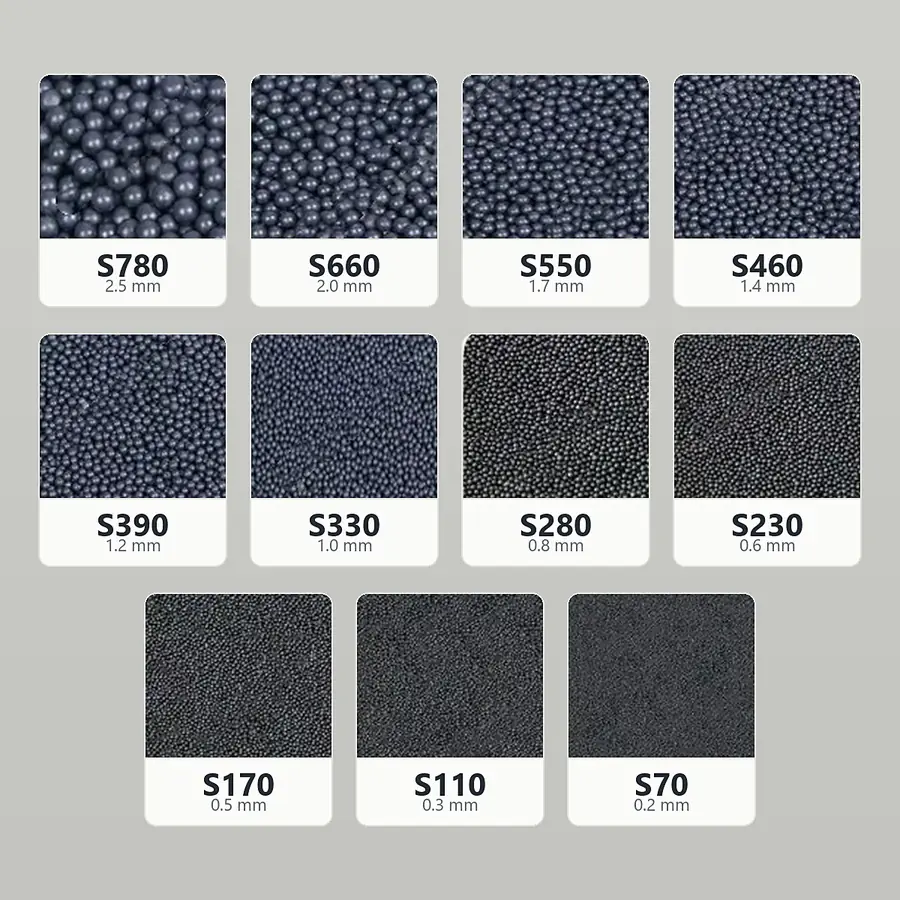
The S number is a diameter, not a quality rating
SAE J444 names each grade after its nominal diameter in ten-thousandths of an inch. S330 reads as 0.0330 in, which is 0.84 mm. S550 reads as 0.0550 in, or 1.40 mm. Nothing in the number says a grade is harder, purer or longer lasting — only how big the particle is.
That single fact explains most of the ordering mistakes we see. A buyer replaces S330 with S550 expecting better cleaning and gets a deeper profile, marked edges on thin sections and a separator that cannot keep up. The data sheet was never the problem; the assumption was.
Grades we supply
Nominal diameters below are the published SAE J444 figures. Each grade is supplied to a sieve distribution around that nominal, so two suppliers quoting “S330” can still deliver different working mixes — the sieve analysis for the batch is the thing worth asking for.
| Grade | Nominal (in) | Nominal (mm) | Where it usually goes |
|---|---|---|---|
| S70 | 0.0070 | 0.18 | Fine finishing, peening of small parts, sheet under 1 mm |
| S110 | 0.0110 | 0.28 | Thin sheet, aluminium and light non-ferrous castings |
| S170 | 0.0170 | 0.43 | Small castings and general light cleaning |
| S230 | 0.0230 | 0.58 | Mixed small-to-medium parts — the commonest starting point |
| S280 | 0.0280 | 0.71 | Medium castings and forgings, 6–25 mm section |
| S330 | 0.0330 | 0.84 | Medium-to-heavy plate, structural steel, H-beams |
| S390 | 0.0390 | 0.99 | Heavy plate and thick mill scale |
| S460 | 0.0460 | 1.17 | Large castings, rough descaling |
| S550 | 0.0550 | 1.40 | Heavy descaling of thick rolled plate |
Coarser grades than S550 are quoted on request for heavy descaling work.
The letter in front is the hardness class
SAE J827 defines four hardness classes. The letter is usually dropped in conversation — most buyers just say “S330” — which is why hardness is the second thing that goes wrong. Standard S suits the majority of cleaning and descaling work; harder classes last longer per particle but are more brittle, and brittle media breaks down into fines your separator has to pull out.
| Class | Hardness | When it earns its price |
|---|---|---|
| S | 40–51 HRC | Standard. Covers most cleaning and descaling work |
| M | 47–56 HRC | Medium. Longer life where breakdown is the main cost |
| L | 54–61 HRC | Hard. Aggressive cleaning, shorter fatigue life per particle |
| H | 60 HRC min | Extra hard. Specialist work; breaks down fast in a wheel machine |
Shot or grit — round against angular
Shot is atomised and round. It hammers the surface and leaves a rounded, uniform profile, which is what you want for cleaning, descaling and peening without cutting into the part. Grit is crushed and angular: it cuts, removes heavy scale faster, and leaves a sharper profile for coatings that need teeth to grip — at the price of faster wear on the wheel, the liners and the parts you are cleaning.
The mistake is buying grit for a machine whose separator was designed around round media. Both leave the same nominal profile number; only one of them keeps the circuit balanced.
Choosing a grade by section thickness
A workable starting point, before you correct it against your own SA requirement: under 6 mm section, S110–S230; 6 to 25 mm, S280–S330; thicker than 25 mm, S390–S460. Then check the two things that outrank the table — the thinnest feature on the part, and the profile your coating supplier will accept.
On mixed production the constraint is always the lightest part, not the heaviest. If one line runs 2 mm brackets and 40 mm castings, a single grade will either mark the brackets or crawl on the castings — which is a machine decision, not a media one.
What actually drives consumption
Media leaves a machine in two ways: it wears down until the separator rejects it as fines, or it leaves through a leak. The first is normal and depends on grade, hardness and wheel speed. The second is free money going into the dust collector, and it hides behind a rising make-up number that looks like a media quality problem.
Record make-up kilograms against tonnes of output for a month. If the ratio is steady, buy the same grade. If it climbs, inspect the separator setting, the chamber liners, the door seals and the dust collector before changing supplier — the wear-part guide walks through the three signals in order.
How we quote it
We quote steel shot by grade, hardness class, tonnage and packing together, because the packing is part of the delivered cost. Tell us what your store can take — 25 kg bags on pallets, one-tonne big bags, or loose in the container — and the price is built around that rather than adjusted afterwards.
Ask for the sieve analysis and the chemistry for the batch you receive. A supplier who cannot produce them for the lot in your yard is re-bagging someone else's media, and you have no way to know what grade you are actually running.
Questions buyers ask
Related: what SA 2.5 and SA 3.0 actually measure, the hook type range, wear parts and accessories, maintenance and wear.
Tell us the machine, and we will size the media
Model, wheel power, section thickness and monthly tonnage — that is enough for a grade, a hardness class and a delivered price.