
A 5-Meter Hook Machine for Uzbek Transformer Plants: Why Size Matters, and How We Delivered It in 7 Days
Some workpieces simply refuse to fit standard machines. Here's what happened when a transformer manufacturer in Uzbekistan needed to blast-clean housings up to 4 meters tall — and why we ended up re-engineering the entire delivery approach.
Machine at a glance
The problem: transformers don't fit in standard machines
Our customer is a power equipment manufacturer in Uzbekistan. They build distribution and power transformers, and before painting they need every housing and tank thoroughly blast-cleaned. Transformer tanks are big. Ours, they told us, are up to 4 meters tall. Add the lifting rig, and you're looking at a workpiece envelope around 2.7 meters in diameter and 4 meters high.
No standard hook-type machine on the market handles that. Off-the-shelf units stop at around 1.8–2.2 meters of chamber height. So the discussion started the only way it could: with the chamber dimensions, not the price.
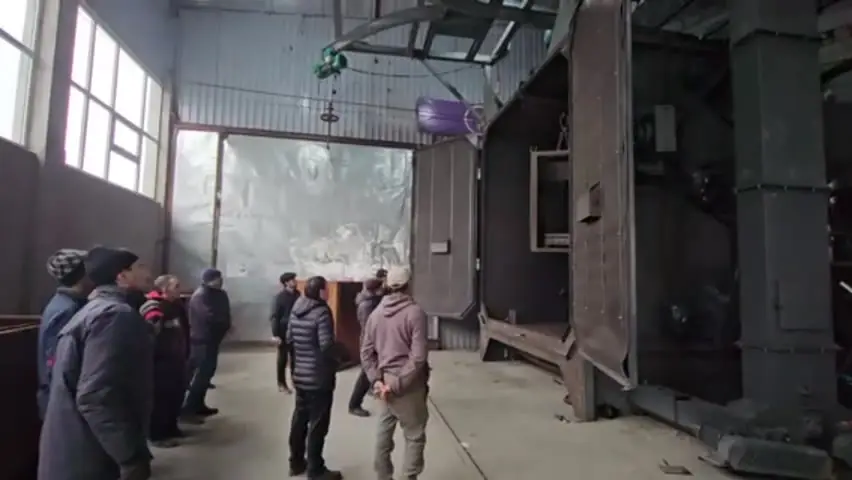
Customer engineers gathered to watch the machine take shape on site.
Sizing the chamber: no room for compromise
We settled on a blast chamber of 3,200 × 3,200 mm and 4,700 mm internal height. That gives the customer a working envelope of Ø2,700 mm in diameter and 4,000 mm in height — enough for their heaviest transformer tanks plus the chains and lifting beam. Any smaller and they'd be back to us within a year asking for a second machine.
The machine carries five 11 kW blast turbines. Two on each side wall and one at the rear, angled so the blast pattern covers the full width of a transformer housing. Transformer tanks are covered in cooling radiators — rows of fins with deep gaps between them. Those gaps are exactly where scale and old paint love to hide, and they're the first thing a customer checks after the first cycle.
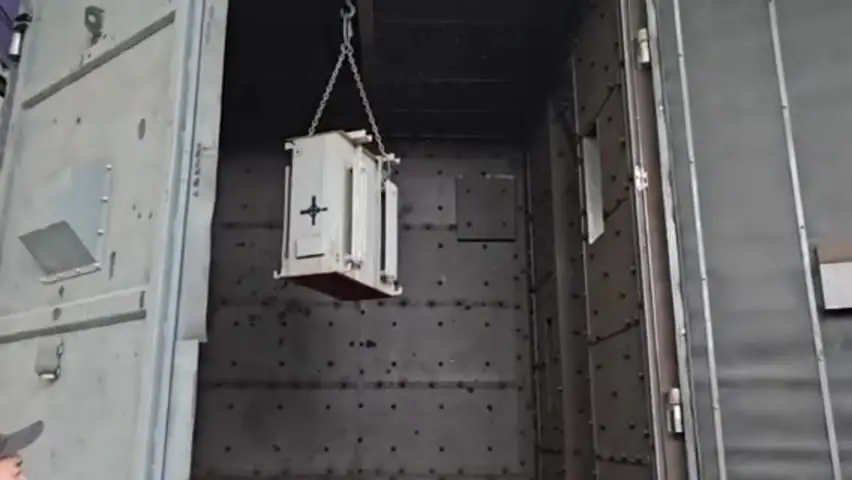
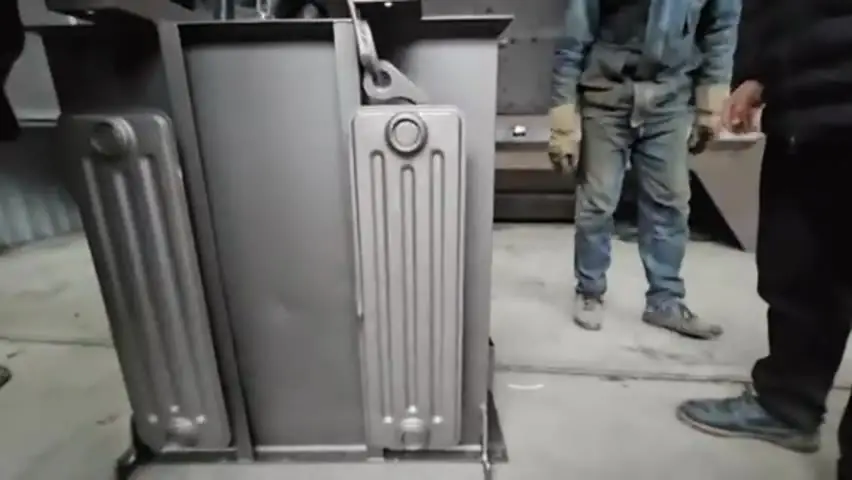
Left: a transformer tank suspended in the chamber. Right: the cooling fins that make this job genuinely difficult.
Twin hoists and exchange rails: safety as a design input
With workpieces this heavy, the hoisting arrangement is a safety feature, not a convenience. We built the machine with twin 2,000 kg electric hoists on an exchange rail system — one hoist positions the load while the other can be shuttled aside. It sounds simple, but it changes the job entirely: operators load and unload without ever standing under a suspended load path, and the rails absorb lateral forces that a single-hook layout would push into the frame.
The exchange rails also let us pre-hang the next workpiece while the chamber is still running. On a machine this size, cycle times run 20–30 minutes per tank, so that overlap saves real hours on a production day.
The part nobody budgets for: getting it there
Here's the thing nobody thinks about when they quote a big machine: a 4.7-meter-tall chamber does not fit in a standard container. Not even close.
Our first plan was a 40-foot flat-rack container. It works — we've shipped machines that way before. But the freight cost for a unit this size was brutal, and the customer's budget was already stretched by the machine itself. So we went back to the drawing board.
The answer was modular design. The chamber ships as floor panels, wall sections, roof, and the elevator/separator assembly — each piece under 3 meters in any dimension. Standard containers, standard handling, no cranes beyond what the site already had. The trade-off is that more assembly happens on site. That's fine. It's what our installation team is there for.
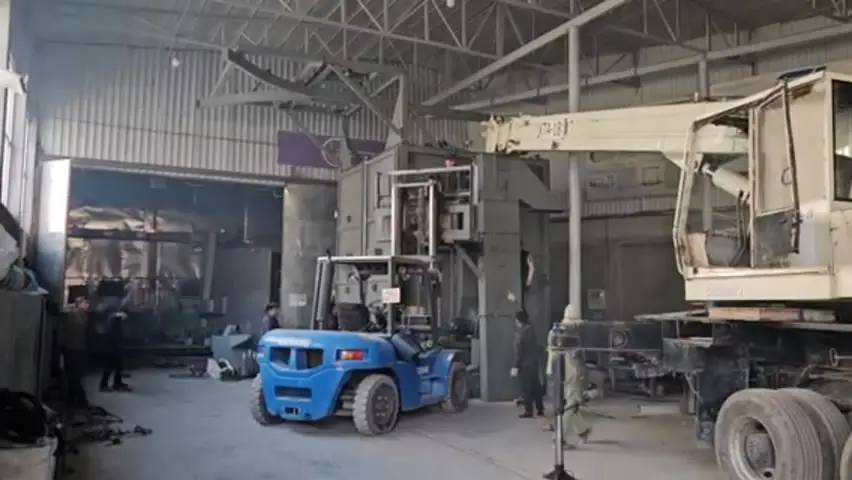
On-site assembly: forklift and mobile crane positioning chamber sections.
Seven days, and no foundation bill
The customer's workshop floor was tight — machines already in place, walkways narrow, and the floor itself wasn't level enough for a machine this heavy without prep work. Normally that means pouring a reinforced foundation and waiting a week for it to cure. We didn't have that week.
Our installation crew did what they've done on tight sites before: leveled the machine on integrated base frames with shims, no concrete pour at all. That decision alone saved the customer the cost of a foundation and kept the schedule intact. Machine delivered, assembled, aligned, and running in 7 days.
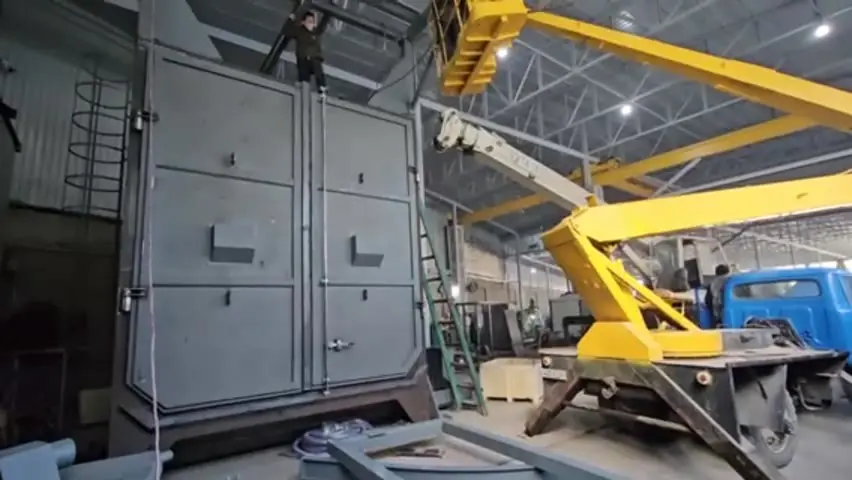
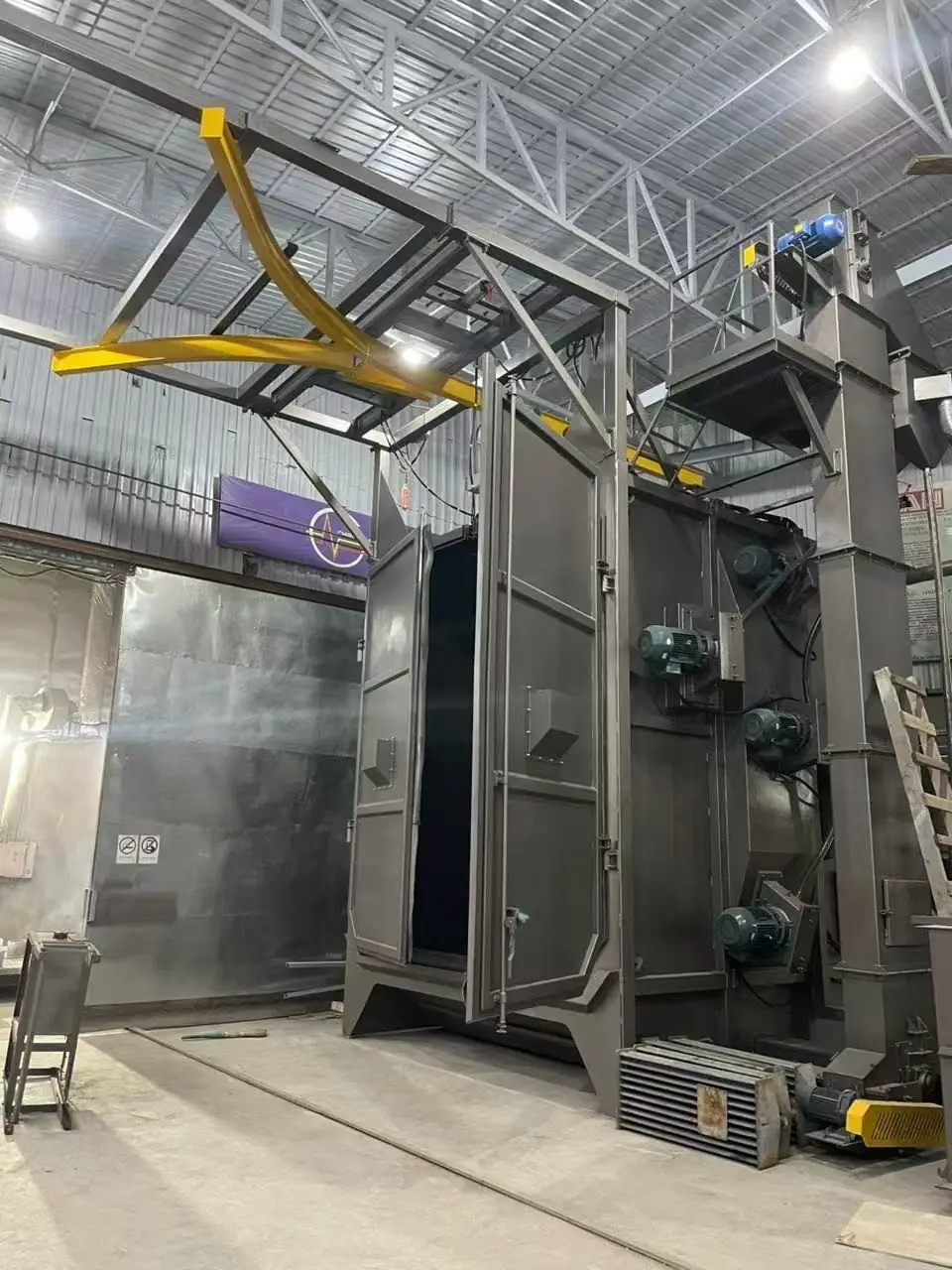
Left: boom lift access during assembly. Right: the machine, running in production.
The result: clean fins, happy engineers
Transformer housings are precision components. Every radiator fin, every corner joint, every dead angle has to be clean before primer goes on — and any spot the blaster misses shows up immediately after painting. The customer's engineers watched the first full cycle closely. We did too.
The five-turbine layout with the angled rear wheel did its job: complete coverage, including the fin gaps. No touch-up blasting needed before painting. The customer signed off on the first test piece.
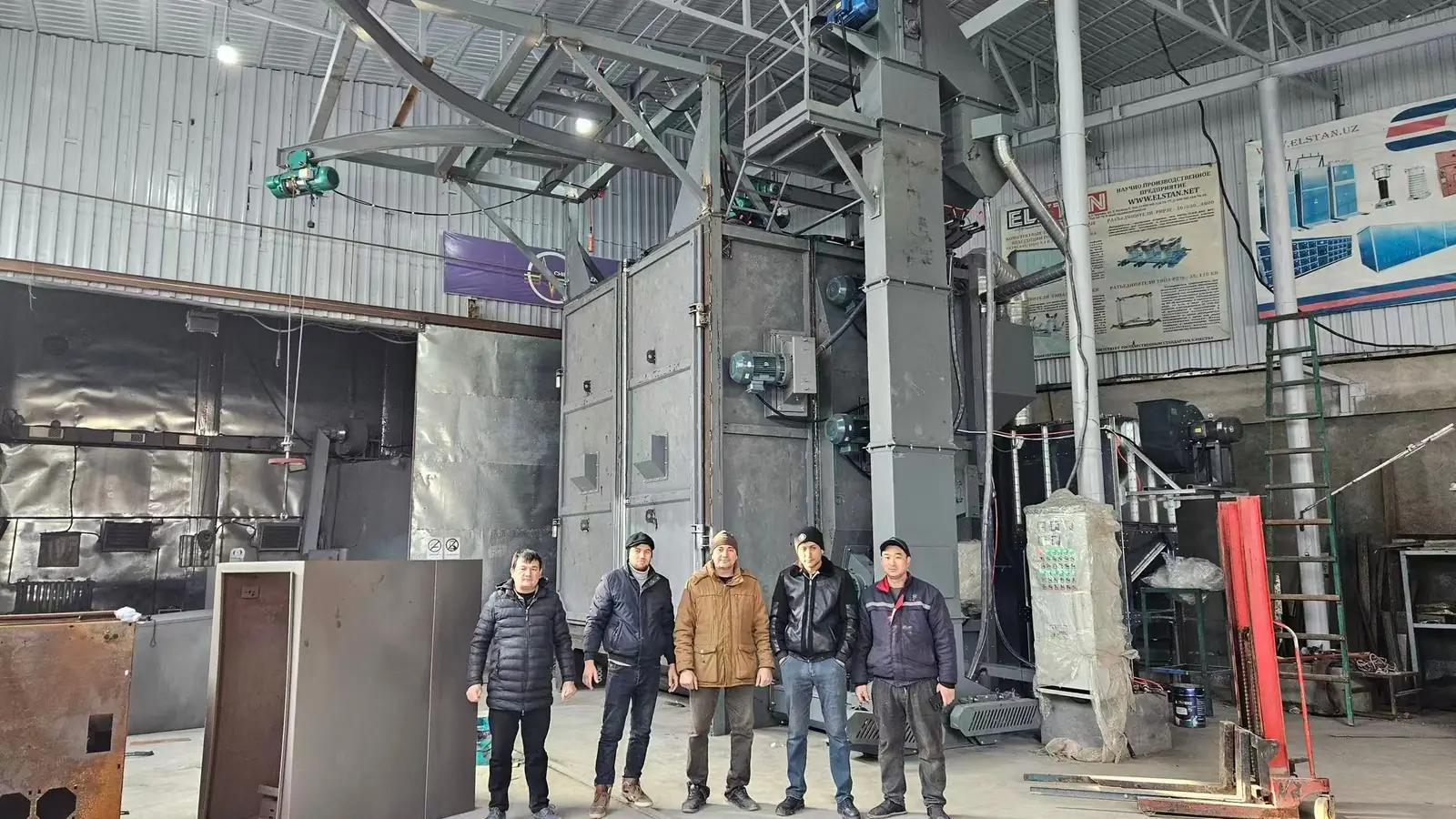
The customer's engineering team in front of their new machine.
What we'd tell another customer in the same position
- Measure the real workpiece, not the nominal one. Add the chains, the lifting beam, the margin. That's your chamber size.
- Ask about the fins. If your parts have deep recesses, the wheel layout matters more than the chamber size.
- Ask how it ships. A modular machine that fits standard containers can save you five figures in freight — and it forces better engineering, not worse.
- Ask about the floor. Integrated base frames with shims can replace a concrete pour, saving weeks.
If your parts fall in the 1–10 ton range, start with our standard hook type shot blasting machine range — and send us your drawings if you need a chamber built around your workpiece.
Project FAQ
How large was this machine?
The blast chamber is 3,200 × 3,200 mm with a 4,700 mm internal height, giving a working envelope of Ø2,700 mm diameter and 4,000 mm height — enough for the customer's heaviest transformer tanks plus lifting rig. It carries five 11 kW blast turbines (two per side wall, one at the rear).
How was it installed in only 7 days?
Modular design. The chamber ships as floor panels, wall sections, roof and the elevator/separator assembly — each piece under 3 meters in any dimension, so it fits standard containers. On site, the crew leveled the machine on integrated base frames with shims, eliminating the concrete foundation pour entirely.
Can Yufei build a similar machine for our plant?
Yes — this project is a template for oversize workpieces. Send us your part drawings and dimensions, and we'll size the chamber, the wheel layout and the shipping method together. If your parts have deep recesses, we'll also check the blast wheel angles against them.
Need a machine that fits your workpiece — not the other way around?
Send us your part drawings and dimensions. We'll size the chamber, the wheels, and the shipping method together.
Related: the hook type range guide, which machine type fits your part.
Send Your Specifications