
A Q376 Hook Type Machine in Kenya, Built for Motorcycle Parts and Welded Assemblies
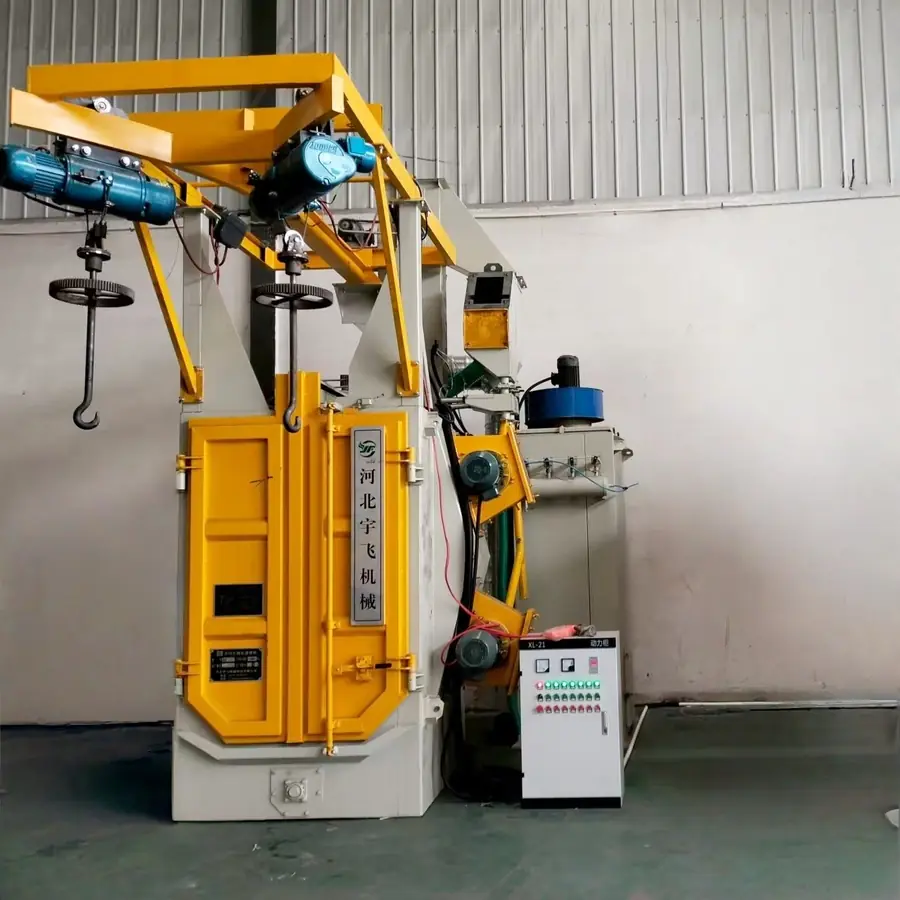
Toprich runs a powder coating plant in Kenya, and blasts motorcycle components and welded steel assemblies to SA 2.5 before coating. The parts are tubular, bracketed and awkward — the kind of load that hangs on a hook more naturally than it tumbles in a barrel. That is a hook machine job, and the machine we built for them is a Q376: two 7.5 kW blast wheels on a 1500 × 1500 × 1800 mm chamber, with a working envelope of Ø1000 × 1000 mm.
Why 1.5 m of chamber for a 1 m part
The numbers that matter to a buyer are the working envelope, not the cabinet. This machine clears a part up to Ø1000 mm across and 1000 mm high. The chamber around it is 1500 × 1500 × 1800 mm, and the 250 mm of clearance on each side is not slack manufacturing — it does three specific jobs.
First, a hook rotates. Anything hanging from it swings as it turns, and a part that touches the wall stops turning and starts rubbing. Wear liners fail from rubbing long before they fail from abrasive impact, so clearance protects the most expensive consumable in the machine. Second, the fixture that carries a batch of small parts eats into the envelope: you need room for the jig as well as the workpiece. Third, the extra height above the load takes the hook spindle and the cross bar, so parts hang clear of the roof plate instead of being dragged through the abrasive stream at the top of the chamber.
The practical rule for a hook machine is to size the chamber around the fixture and the swing, then confirm the envelope. Sizing it around the part alone is how buyers end up with a machine that fits the drawing and jams on the first real load.
Two 7.5 kW wheels, not four
Wheel count is the first thing most quotations argue about. On a 1 m envelope, two 7.5 kW wheels are enough, because the part rotates through the stream. Each wheel covers roughly half the rotation path, and every surface of a tubular frame passes both streams as the hook turns through a full revolution. A four-wheel layout on the same envelope would add power draw and cost without adding much coverage — the second pair would fire into the same rotation path.
Where four wheels do earn their price is a large envelope with heavy plate: the part is bigger, the rotation path is longer, and the extra wheels shorten the cycle. For motorcycle frames and welded brackets at this size, two wheels at 7.5 kW keep the cycle short and the connected load modest, which matters when the plant's supply has to carry the machine plus a coating line.
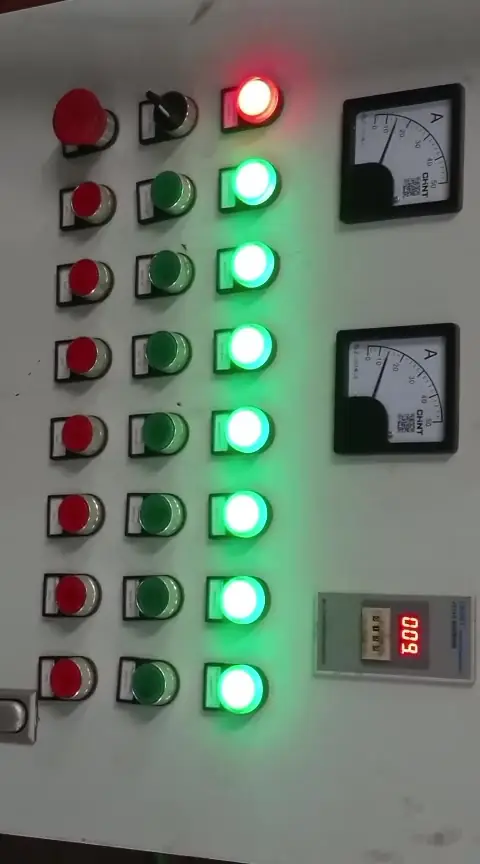
Both wheel currents are visible on the panel ammeters, so the operator can see the load during a run rather than guessing from the sound. The digital display next to them is the blast timer.
Manganese where the abrasive lands, NM500 where it does not
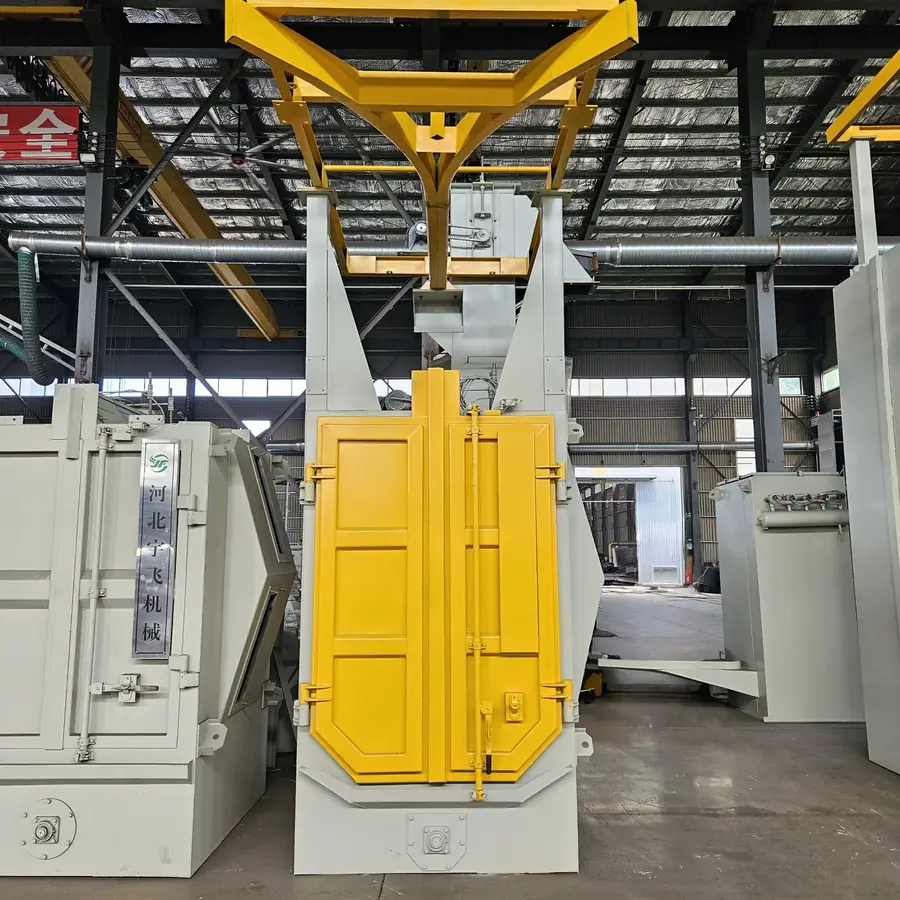
A blast chamber is not uniformly worn. The wall directly in front of a wheel takes the full stream at high velocity; the corners, the roof, the door frames and the lower hopper take reflected abrasive at a fraction of the energy. Lining the whole cabinet in the same material is the simplest way to build a machine, and the most expensive way to own one.
On this Q376 the hot zone — the area in the direct line of the two wheels — is lined with rolled manganese steel. Manganese work-hardens under repeated impact: the surface gets harder as it is hit, which is exactly the behaviour you want where the abrasive stream lands. The non-hot zones use NM500 wear plate, which is hard and affordable but does not need to absorb the same impact energy.
The result is a machine where the parts that actually wear out are the parts built for wearing out, and the rest of the cabinet is not over-specified. That is the honest way to hold a price: take the cost out of the areas that will not fail, not out of the areas that will. Buyers comparing quotations should ask which zones are manganese and which are not, because a single-material quotation and a zoned quotation look identical on a spec sheet and behave very differently in year three.
What the machine was asked to clean
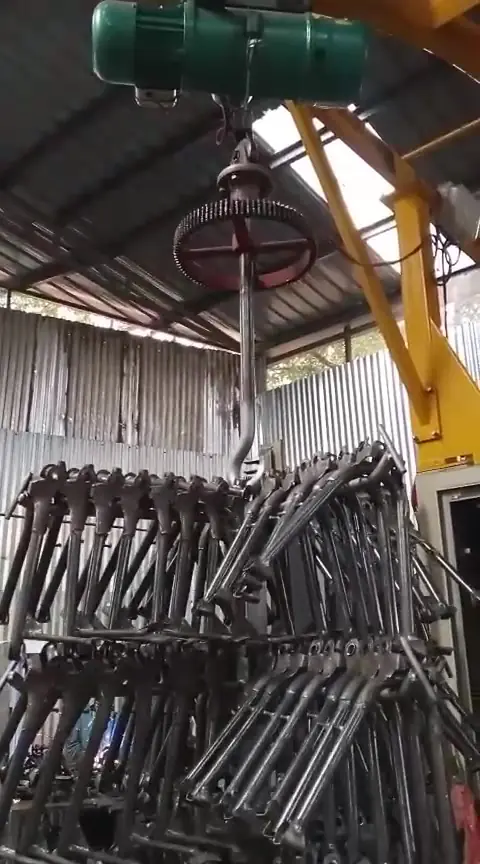
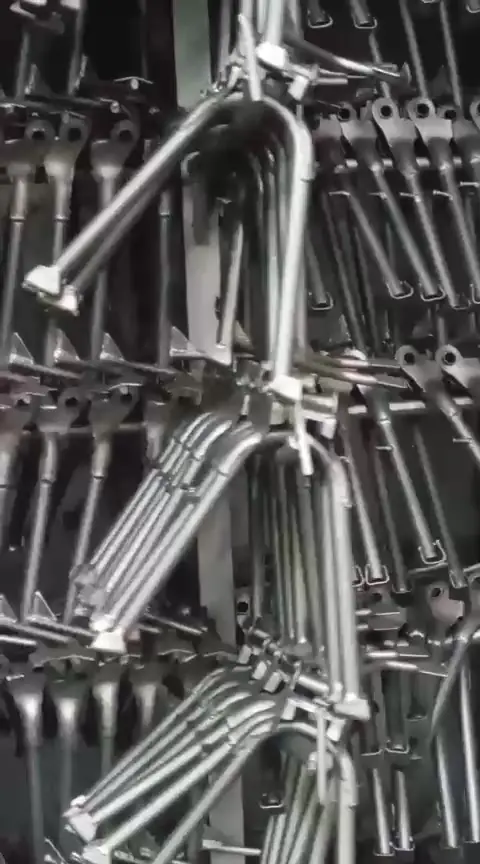
The load is typical of a two-wheeler supply chain: welded tubular frames, footpeg brackets, handlebar assemblies and small fabricated weldments. Parts like these arrive with mill scale, welding discolouration and light rust on the weld seams, and they have to come out uniformly grey at SA 2.5 before the powder goes on — any patch the blast misses shows through the coating as a shadow.
Tubular geometry is the reason a hook machine wins here. A barrel tumbler would let frames nest into each other and shield the inside of the tubes; hanging them from a rotating hook exposes every face to the stream in turn. The three frames below are from the customer's own video: the batch going on the hook, the control panel during the run, and the same frames after the blast.
Commissioning without a flight to Nairobi
This machine was not installed by our engineers on site. It was commissioned remotely: drawings out, video calls in, and the customer's own team doing the physical work. That arrangement is not a shortcut, and it is not right for every buyer — but for a plant with competent maintenance staff it saves a week of travel, visas and hotel costs, and it leaves the customer's team knowing the machine rather than watching someone else run it.
What we send is the set of documents a local team actually needs: the foundation and anchor layout, the general arrangement drawing with clearance around the doors and the hook rail, the electrical wiring diagram for the panel, and the wear-part map showing which liner goes where. What we ask for in return is a level foundation, anchor bolts set to the drawing, a supply brought to the panel by a local electrician, and a phone propped up somewhere it can see the machine.
Then the sequence, in the order it has to happen: check the wheel rotation direction before anything goes in the chamber, run empty and listen, set the blast timer, load one hook with scrap parts, and only then commit a production batch.
On this machine the rotation check was done on site before the first batch went in: both wheels confirmed turning the right way. It is the step most often skipped, and the one that costs the most when it is. A wheel running backwards throws abrasive into the wrong part of the chamber and wears the liner instead of the workpiece — and by the time the finish looks wrong, the liner has already taken the damage.
The customer's feedback after the first production runs was straightforward: the machine does what the drawings said it would, the parts come out clean, and the support was there when the questions came up. Two clips filmed on their own floor are below.
The build sheet
| Item | Specification |
|---|---|
| Customer | Toprich — powder coating, Kenya |
| Model | Q376 hook type shot blasting machine |
| Chamber (internal) | 1500 × 1500 × 1800 mm |
| Max cleaning envelope | Ø1000 mm × 1000 mm high |
| Blast wheels | 2 × 7.5 kW |
| Hot zone lining | Rolled manganese steel |
| Non-hot zone lining | NM500 wear plate |
| Workpieces | Motorcycle components, welded steel assemblies |
| Surface preparation | SA 2.5 before powder coating |
| Commissioning | Remote: drawings plus video guidance |
Chamber and envelope figures are for this build. A Q376 can be configured with a different chamber, wheel count or lining schedule — the frame and the hook system stay, the numbers around them do not.
If you are building a similar machine
Three things decide whether a hook machine fits your parts, and all three are answerable before anyone quotes a price.